Meal Planning for Shift Workers: A Practical Guide
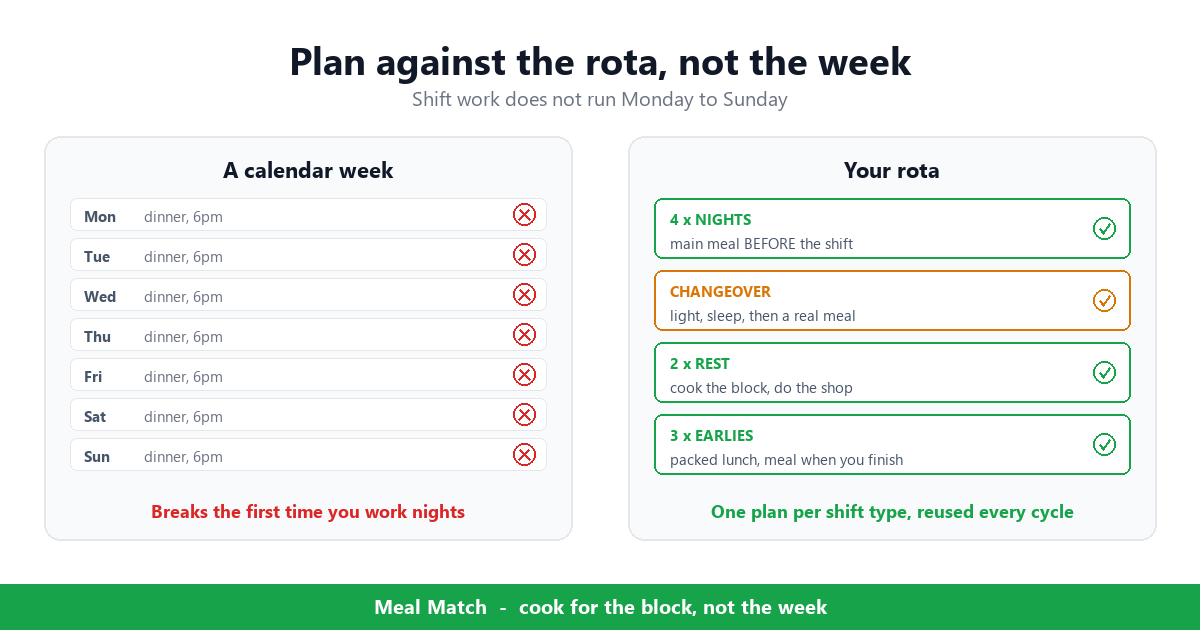
Almost every meal planning guide ever written assumes you get up in the morning, eat three meals, and go to bed at night. If you work nights, rotating shifts, or a four-on-four-off pattern, that advice quietly fails on the first day — because your week doesn't run Monday to Sunday, and "dinner" isn't a time of day. This guide is about planning food around a rota instead of a calendar: what to cook and when, what actually works at 3am, and how to handle the changeover days where eating usually collapses.
Why normal meal planning breaks on shifts
It isn't willpower. It's that the standard advice assumes three things shift work removes.
- A fixed week. A plan written for Monday to Sunday is useless when your Monday is a rest day one week and the third of four nights the next.
- Shops being open when you are awake. Finishing at 7am puts you in a supermarket at exactly the wrong moment — tired, hungry, and about to make every food decision for the next four days.
- Eating at conventional times. When your main break falls at 2am, "what's for dinner" is not a question with an obvious answer, and the vending machine is very happy to answer it for you.
So the fix isn't more discipline. It's building the plan around the unit that actually governs your life: the shift block.
Step 1: Plan against the rota, not the week
Take your actual rota and group the days by type rather than by date. Most patterns reduce to four kinds of day:
- Rest days — normal eating, and where the cooking happens
- Earlies — the challenge is breakfast and an early, portable lunch
- Lates — the challenge is not arriving home at midnight starving
- Nights — the challenge is everything
You don't need a different meal for all seven days. You need a plan for each type of day, reused every time that day comes round. That is a much smaller problem, and it survives the rota changing.
Step 2: Pick one anchor meal per shift type
An anchor is the one substantial meal you commit to, at a fixed point relative to the shift. Everything else can be flexible.
| Shift | Anchor meal | What the rest of the day looks like |
|---|---|---|
| Early | A real meal when you finish | Something quick before you leave, a packed lunch on shift, lighter evening |
| Late | A proper meal before you go in | Something small on the break, and a plan for arriving home so you're not cooking at midnight |
| Night | A proper meal before the shift | Lighter food on the break, something small on the way home if you need it |
| Rest | Whenever suits | This is your cooking day |
The single most useful change most night workers make is moving the main meal to before the shift rather than during it. You go in fed, the 3am decision gets much smaller, and you're not trying to digest a full dinner at the point your body least wants to.
Step 3: Cook once for the whole block
Four nights doesn't mean four dinners. It means four portions — and probably of only one or two dishes.
Pick the last rest day before a run of shifts and cook in quantity. Things that reheat well and don't mind a fourth day in the fridge do the heavy lifting: chilli, dal, a big tray of roasted vegetables, a curry, a pasta bake, soup. Portion straight into containers while it's still warm, so the decision is already made when you're tired.
If you already batch cook, you're most of the way there — our batch cooking guide covers the mechanics. The shift-work adjustment is simply when: cook to the block, not to the week.
Freeze one or two extra portions every time you do this. Within a couple of cycles you'll have a small bank of meals for the nights when the cooking day gets swallowed by real life — which it will.
Step 4: Pack for the break you actually get
This is where good intentions most often fail. People pack food for the break they're supposed to get rather than the one they get.
Two questions decide what you take:
- What are the facilities really like? If there's no microwave, or one microwave and fifteen people, hot food is a plan that depends on luck. Food that's genuinely good cold removes the problem.
- Can the break be cut short? If it can, take something you can eat in pieces rather than a single sit-down meal — you'll actually eat it.
Things that hold up well: pasta or grain salads, frittata slices, boiled eggs, oatcakes and nut butter, hummus with vegetables, tinned fish, yoghurt, fruit, unsalted nuts. Things that reliably disappoint: anything that goes soggy, anything needing assembly, and anything that only works hot.
Take more water than feels necessary. Warm buildings and long shifts are dehydrating, and thirst is very easily mistaken for hunger at four in the morning.
Step 5: Give the changeover days their own plan
Ask anyone who works rotating shifts where their eating falls apart and they'll say the same thing: the day you switch. You finish a run of nights, get home at 8am, and the next 24 hours belong to nobody — not quite a working day, not quite a rest day.
Plan that day explicitly rather than leaving it to chance:
- Something light when you get in. A large meal right before sleeping tends to make the sleep worse, and you're usually more tired than hungry.
- Sleep.
- A proper meal when you wake, treated as the start of a normal day.
One easy meal, decided in advance and already in the fridge, is worth more on that day than a perfect plan for the rest of the week.
Caffeine: the one bit of timing worth getting right
Caffeine is how most shift workers get through nights, and it's also the most common reason they can't sleep afterwards. It takes several hours to clear your system, so a coffee at 5am is still working at 9am when you're trying to sleep.
The usual advice is to front-load it — use it in the first part of the shift, then switch to water for the last stretch. Exactly how many hours you need depends heavily on the person, so use your own sleep as the evidence. If you're lying awake after a shift, the coffee timing is the first thing to change.
Shopping when the shops are shut
Fix the shop to your rota the same way you fix the cooking. A delivery slot booked for a rest day, or one shop on the same point of every cycle, means you never shop tired and never shop hungry.
Build the list from the plan rather than wandering the aisles — you're buying four portions of two dishes plus the packable items, not a week of ideas. It's shorter, it's cheaper, and it doesn't rely on you making good decisions at the end of a night shift, which is not the moment anyone is at their best.
Let the plan build itself.
Tell Meal Match your diet, budget, household size, allergies and any medical needs, and it builds a personalised 7-day plan with one shopping list. Generate it on your rest day before a run of shifts and you've got the whole block covered — cooking, portions and shop, decided while you're awake enough to decide.
Start your free 3-day trial →FAQ
What should you eat on a night shift?
Most people do better with a proper meal before the shift and lighter food during it, rather than a full meal in the small hours. Heavy, fried or very large meals at 3am often sit badly and make the last hours harder. Aim for something with protein and fibre that releases slowly, and keep portions moderate. Individual needs vary, so treat this as a starting point rather than a rule.
When should I stop drinking coffee on a night shift?
Caffeine takes several hours to clear, so drinking it late in a shift can make it much harder to sleep when you get home. A common approach is to stop a good few hours before the end and switch to water. Sensitivity varies a lot between people — adjust based on how well you actually sleep afterwards.
How do you meal prep for shift work?
Cook for the block, not the week. Batch cook on your last rest day before a run of shifts, portion straight into containers, and plan around the break and facilities you actually get. Two dishes cooked in quantity will cover four nights far more reliably than four different meals planned individually.
How do I shop for food when I work nights?
Fix a regular slot rather than shopping whenever you happen to be awake. An online delivery booked for a rest day, or one shop at the same point in each rota cycle, removes the decision entirely. Shopping after a night shift while tired and hungry is the most expensive way to buy food.
Does eating at night cause weight gain?
The picture is more complicated than a simple yes or no, and research on shift work and health is ongoing. What is clear in practice is that nights make it easy to eat more without noticing — vending machines, takeaways and grazing across a long shift add up quietly. Planning what you eat, rather than deciding at 3am, addresses that directly. For advice specific to you, speak to your GP or a registered dietitian.
Can a meal planning app work around shift patterns?
Yes, provided you use it for the block rather than the calendar week. Meal Match builds a personalised 7-day plan and one shopping list from your diet, budget, household size, allergies and any medical needs. Generate it on the rest day before a run of shifts and treat it as the food for that block.