Meal Planning for One Without Wasting Half of It
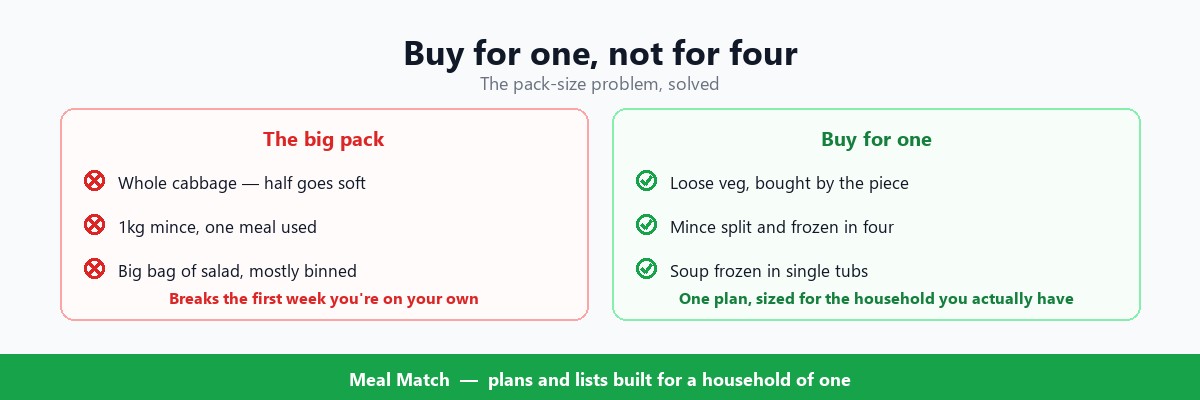
Buy a family-sized bag of anything and you already know how this ends. Half gets used. The rest sits at the back of the fridge going soft until you're apologising to nobody while you scrape it into the bin. Cooking for one isn't a smaller version of cooking for a family. It's a different problem, and the recipes and pack sizes on the shelf are mostly built for the other one.
The problem is the pack size, not you
We've written before about general household food waste: planning ahead, storing things properly, using the "eat me first" shelf. That advice still applies. But if you live alone, most of your waste has a narrower, more specific cause: everything in the shop is sized for two or four people, and a lot of recipes assume the same.
A cabbage doesn't come in a one-portion size. Neither does a bag of spinach, a bunch of coriander, or most bags of onions. You buy the smallest one on offer, use a fifth of it, and the rest quietly goes off before you get back to it. That's not a willpower problem. It's a mismatch between how the food is packaged and how much of it one person actually needs in a week.
Scaling a recipe down without losing the plot
Some parts of a recipe scale cleanly. Rice, pasta, most meat and most vegetables can be measured by weight or count, so cutting a recipe for four down to one is mostly division. A quarter of 800g mince is 200g. A quarter of four chicken thighs is one chicken thigh. Easy.
Other parts don't divide at all. A tin of tomatoes is a tin of tomatoes. There's no clean way to cook with a quarter of one. Stock cubes, jars of curry paste, tubes of tomato purée and blocks of coconut cream are the same: fixed units that come in one size regardless of who's eating.
The fix isn't to fight the tin. It's to cook with the whole thing and freeze what you don't use. Open a tin of tomatoes for one portion of pasta sauce, and freeze the other three-quarters in a small tub. Next time you need tinned tomatoes, you've already got them, portioned, with no tin to open at all. Do this consistently and the "fixed unit" problem mostly disappears.
Loose beats bagged, most of the time
A three-pack of peppers is only good value if you use all three before they go soft. For one person cooking three or four times a week, that's often not true, and the leftover peppers become exactly the kind of waste this whole problem is about.
Buy loose: one onion instead of a net of six, a single carrot instead of a bag, one pepper instead of three. The quantity in your basket then matches what tonight's recipe actually needs. It usually costs a little more per item. It also means nothing goes in the bin unused, which more than makes up for it. Most big UK supermarkets sell the basics loose: onions, carrots, potatoes, peppers, garlic, and often apples and bananas too. It's worth using that option before reaching for the bag out of habit.
What actually freezes well (and what just goes mushy)
The freezer is the single most useful tool for cooking alone, but only for the right things. Water-heavy raw vegetables and anything held together by structure rather than fat tend to fail badly. Cooked, fatty, starchy things tend to freeze beautifully.
| Freezes well | Doesn't freeze well |
|---|---|
| Cooked rice and pasta, cooled quickly | Whole lettuce, cucumber, salad leaves |
| Bread, sliced (toast straight from frozen) | Boiled potatoes (go grainy) |
| Stews, curries, bolognese, chilli, soup | Cream-based sauces (tend to split) |
| Grated cheese | Whole raw tomatoes |
| Raw meat, portioned before freezing | Single eggs in the shell |
| Herbs chopped into oil, frozen in an ice tray | Mayonnaise-based salads |
The pattern is simple enough once you see it: things with fat or starch holding them together survive being frozen and thawed. Things that are mostly water and structure (a lettuce leaf, a raw tomato, a boiled potato) don't. When in doubt, freeze the cooked version rather than the raw ingredient.
Run a freezer inventory, or it becomes a lost-property box
An unlabelled freezer is where food goes to be forgotten, not preserved. The fix is boring and it works: a list, either on a card taped to the freezer door or in a notes app on your phone, of what's in there and when it went in.
Add a line every time something goes in. Cross it off when it comes out. It takes about fifteen seconds and it means you actually know, at a glance, that there are two portions of chilli and a bag of frozen spinach in there before you do a big shop and buy more of the same thing by accident. Label each portion itself too: what it is and the date. A tub that says "chilli, 4 Aug" gets eaten. A mystery tub gets left until it's freezer-burnt and binned anyway.
One cook, three different meals
Cooking for one goes wrong fastest when the answer to "what shall I make" is always a full recipe eaten as three or four identical dinners. By day three, most people give up and order a takeaway instead. Which defeats the entire point.
The better pattern is to cook once and let the meal change shape across the week. A roast chicken, for example: chicken and vegetables on the first night, the leftover meat shredded into a stir fry or curry on the second, and a soup made from the carcass and any scraps on the third. Freeze a portion or two of that soup for a week you don't feel like cooking at all.
A pot of bolognese base works the same way. Spaghetti bolognese the first night, the same base spooned over a jacket potato the second, and a thicker, bean-added version as a chilli-style soup the third. One shop, one cooking session, three meals that don't feel repetitive. It's a small step up from straightforward batch cooking, applied to a household of one instead of a family.
How Meal Match handles a household of one
Most meal planning tools are built around a family and expect you to do the halving yourself. Meal Match asks for your household size directly, along with your diet, budget, allergies and any medical needs, and generates a personalised 7-day meal plan with an automatic shopping list sized for one, not a four-person recipe with a note at the bottom telling you to adjust. It's available on the web, on Google Play and on the App Store, and it starts with a free 3-day trial.
Because the list is built from the plan's actual servings, you're not stood in front of a bag of five onions wondering whether to buy it. If you're new to planning generally, our 6-step method for meal planning covers the routine end to end.
Get a plan sized for one
Tell Meal Match your household size, diet, budget, allergies and any medical needs. It builds a 7-day plan and a shopping list matched to how much you'll actually eat, not what the pack size decided for you.
Start your free 3-day trial →FAQ
How do I scale a recipe down to one portion without the maths going wrong?
Scale the parts that divide cleanly: rice, pasta, meat by weight, most vegetables. Treat the parts that don't as fixed units instead of fighting them. A tin of tomatoes, a stock cube or a jar of curry paste doesn't shrink to a quarter, so cook with the full tin and freeze what you don't eat rather than trying to measure out an eighth of it.
Should I buy loose vegetables or a bag when I'm cooking for one?
Loose, most of the time. A bag of five onions is only good value if you use all five before they sprout, and for one person that's rarely true. Buying loose lets you match the quantity to the recipe: one onion, two carrots, a single pepper. Nothing sits in the drawer going soft while you decide what to do with the rest.
Which foods actually freeze well as single portions, and which just go mushy?
Cooked rice, pasta, bread, stews, curries, bolognese, soup, grated cheese and portioned raw meat all freeze well. Whole lettuce, cucumber, salad leaves, boiled potatoes and cream-based sauces don't. They turn watery or grainy on thawing, so buy or make those closer to when you'll actually eat them.
What do I do with half a tin, jar or packet I can't use up?
Freeze it in a small tub or an ice-cube tray rather than leaving it open in the fridge. Tomato purée, stock, coconut milk, chopped herbs and leftover wine all freeze in small amounts and defrost fast, so half a tin becomes four future dinners' worth of flavour instead of one forgotten jar at the back of the shelf.
How do I stop eating the same meal three nights running?
Cook the base once and change the ending. A roast chicken becomes chicken and veg on night one, a stir fry or curry with the leftover meat on night two, and a soup from the carcass and scraps on night three. Same shop, same cooking session, three different dinners.
Do I need a bigger freezer to cook properly for one?
No. A few flat, labelled tubs or freezer bags laid flat to stack use far less space than most people expect. The freezer drawer that comes with a standard fridge-freezer is usually enough once portions are flat-packed rather than dumped in as whole containers of stew.
Can Meal Match build a plan for a household of one?
Yes. Set your household size to one and Meal Match generates a personalised 7-day meal plan and a shopping list sized for that (not a family recipe halved on the page), and it starts with a free 3-day trial. The list matches the plan's actual portions, so you're not buying quantities meant for four.
How long can I safely keep a portioned meal in the freezer?
Most cooked meals keep well for about three months in a domestic freezer, though quality drifts down gradually rather than food becoming unsafe overnight. Cool food quickly before freezing, label it with the date, and follow UK Food Standards Agency guidance on freezing and defrosting for the specifics that matter for safety.